|
|
 Re: v-twin
|
Joined: Nov 2011
Posts: 688
Adjunct
|

Adjunct
Joined: Nov 2011
Posts: 688 |
Quote:
An air cooled transverse vertical twin is a horrible design. First off, it's much wider than it needs to be. The longer radius that all that metal has to traverse has an adverse effect on handling.
Second, the bore size is limited by how far apart the rider can comfortably spread his knees. This is the reason Norton had to cant the cylinders forward to get enough bore to make 850 CC's.
Third, there are cooling fins on only 3/4 of the cylinder because the other cylinder is in the way of the remaining fourth. This results in uneven heating/cooling that distorts the cylinders, increasing wear and causing seriously complex design problems.
The rear cylinder didn't always run hot on a traditional V twin. Before the politicians fancied themselves to be engineers, the 90 degree timing offset caused the rear cylinder to get less than a fair share of air/fuel mixture. At idle, it would only have enough mixture to fire maybe every second or third power stroke, resulting in the traditional raggedy idle. At small throttle openings, both cylinders fired every power stroke, but the rear still had a smaller air fuel charge. By the time the throttle was opened enough and the engine turned fast enough to offset the timing differences, the bike was going fast enough to supply plenty of cooling air front and back.
Ok, I'm new around here so I don't intend to offend but I've got to respond.
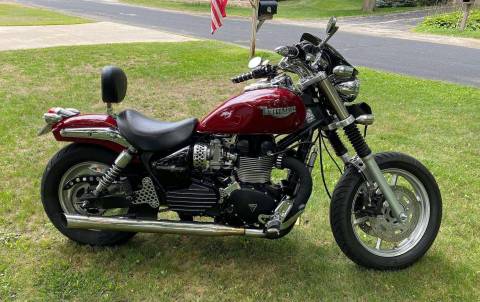
First, the width argument. On a cruiser like the America with forward controls the width of the fuel tank is the limit for the riders legs. The tank on the America is 19 inches wide at the area above the cylinders which means the cylinders are not a problem. As a matter of fact there is enough room under there to run a couple much larger cylinders without limiting the rider. And there is no large air filter housing sticking out beyond the tank on the right side like a typical V-twin. The Triumph 865 has the added benifit of much stronger crankshaft support with main bearings on both sides of each rod journal.
Second, cooling issues. Comparing an air-cooled parallel twin (Triumph) to an air cooled V-twin (Harley) the significant advantage goes to the parallel twin. As the motorcycle moves cooling air flows around both parallel twin cylinders as equally as possible and the hottest part of the cylinder head (the exhaust port) is facing forward into the air flow. By comparison the V-twin's rear cylinder is tucked out of the air flow and it's exhaust port is facing the rear of the bike. Run a V-twin at speed for a while then get off and check the temperature of each cylinder with an infrared thermometer. Huge difference. As a bonus the parallel twin keeps both hot exhaust pipes as far away as possible from the rider.
The results? On the air cooled V-twin the design of the engine causes the cylinders to produce unbalanced power because of significant diferences in operating temperature and usually unequal exhaust and intake routing. Balance is key to engine durability and power output. But if all you want is a lopey sound and vibration you cant beat the Harley.
Harley had the opportunity and certainly the resources to re-engineer their signature air cooled V-twin engine to be a best-in-class contender but they let Victory beat them to it.
2011 Triumph America (10/2011 to 07/2014)
2012 Harley Davidson 1200C Sportster
2014 Harley Davidson Dyna Wide Glide
|
|
|
|
|
|
|